
Economists highlight that resolving domestic policy bottlenecks, particularly through land reforms and improving the ease of doing business, will be critical for Prime Minister Narendra Modi's 'next-generation reforms' and India's economic transformation towards its 'Viksit Bharat' vision for 2047.

India's economy in FY26 saw significant momentum from investment demand, with gross fixed capital formation (GFCF) accelerating to 8.2 per cent, while private final consumption expenditure (PFCE) also grew steadily, according to provisional estimates.

India's retail inflation, measured by the Consumer Price Index (CPI), increased to 3.48 per cent in April, up from 3.40 per cent in March, primarily due to a surge in prices of gold and silver jewellery, as well as certain kitchen staples like tomatoes and cauliflower.

Revenue collection next financial year may be affected, and, along with this, subsidies on food and fertilisers can go up if the war in West Asia drags for long, according to experts.

Supported by strong buoyancy in public sector capital expenditure (capex), growth in infrastructure investment is expected to accelerate in 2025-26 (FY26) compared to 2024-25 (FY25), according to the First Advance Estimates of gross domestic product (GDP) for FY26 released by the National Statistics Office (NSO) on Wednesday.

Nirmala Sitharaman moved into her Kartavya Bhavan office on October 2, in time to get the work on the Budget 2026-2027 going.

India, the world's fourth largest economy, is set to maintain the 'goldilocks' phase with tailwinds of good growth, low inflation and robust banking performance as well as reform initiatives poised to sustain the economic pace witnessed during 2025.
The Indian economy is likely to grow at 7.4 per cent in 2025-26, up from 6.5 per cent in the previous fiscal, mainly on account of better performance of manufacturing and services sectors, as per the government data released on Wednesday.

Rating agencies Crisil and Icra on Monday revised down their India growth projections for the current fiscal and the second quarter mainly due to the ripple effect of slowdown in global growth and mixed crop output. Crisil downgraded the India growth forecast by 30 bps to 7 per cent while Icra pegged the economic expansion at 6.5 per cent for the second quarter of FY2022-23. "We have revised down our forecast for real gross domestic product growth to 7 per cent for fiscal 2023 from 7.3 per cent, primarily because of the slowdown in global growth that has started to impact our exports and industrial activity.

The economy is likely to log in a tepid 6 per cent growth next fiscal, in line with the consensus estimates, rating agency Crisil said on Thursday. The agency also sees the economy averaging a growth rate of 6.8 per cent over the next five fiscals. Crisil further said it expects the corporate revenue to log in double-digit rise again next fiscal.

The repo rate cut by 25 basis points by the monetary policy committee (MPC) of RBI announced Friday will give a long-awaited relief on interest rates and also be supportive of economic growth, according to experts. Repo rate is the interest rate at which the RBI lends money to commercial banks.

Crisil Ratings on Wednesday projected India's GDP growth at 6.8 per cent in the next fiscal and said the country will become an upper middle-income nation by 2031 with the economy doubling to $7 trillion. In its India Outlook report, Crisil said the Indian economy will take support from domestic structural reforms and cyclical levers and can retain -- perhaps even improve -- its growth prospects to become the third largest economy by 2031. "After a better-than-expected 7.6 per cent this fiscal, India's real GDP growth will likely moderate to 6.8 per cent in fiscal 2025," said the Crisil India Outlook report.

The report mentioned that the government spends 2.2 per cent of the GDP on pension bill.

The agency has predicted that monsoon will also be a major factor.

The agency welcomed the Rs 1.70-lakh crore package announced by Finance Minister Nirmala Sitharaman earlier in the day but said more measures like loan forbearances for small businesses and households are necessary.

'The central bank has highlighted that the slowdown in growth has been limited to a few sectors and overall growth is expected to pick up in the second half of the year.'

Dr Nagesh Kumar, one of the three new MPC members, wanted the MPC to reduce the repo rate by 25 basis points to 6.25%.

Amid low growth elsewhere, gross value added (GVA) growth in agriculture and allied activities recovered during the second quarter of the current financial year (Q2FY25) to 3.5 per cent year-on-year (Y-o-Y) due to strong monsoon. Experts feel that the rains have laid the foundation of an even better GVA performance in subsequent quarters. GVA growth in the first quarter of FY25 was 2.0 per cent.
.jpg)
The agency also warned the government of overshooting the fiscal deficit target at 4.8 per cent due to poor revenue growth and pegged it at 5.2 per cent this fiscal.

Retail inflation eased to an 11-month low of 4.83 per cent in April as prices of some kitchen items declined though overall food basket firmed up marginally, according to a government data released on Monday. The Consumer Price Index (CPI)-based retail inflation was 4.85 per cent in March. It was 4.7 per cent in April 2023.

'The Budget needs to focus more on social welfare schemes.'

India can become a $6.7 trillion economy by 2031, from $3.4 trillion currently, if the country clocks an average growth of 6.7 per cent for 7 years, an S&P Global report said on Thursday. India had clocked a 7.2 per cent GDP growth in 2022-23 fiscal. But a global slowdown and lagged effect of a policy rate hike by RBI could slow down growth to 6 per cent in the current fiscal, S&P Global said in a report titled 'Look Forward: India's Money'.

The Interim Budget for 2024-25 (FY25) to be presented on February 1 is likely to assume 10-10.5 per cent nominal gross domestic product (GDP) growth against 8.9 per cent estimated for FY24 by the National Statistical Office (NSO). "We were waiting for the First Advance Estimates GDP numbers for FY24. "We will finalise the nominal GDP growth assumption for FY25 Interim Budget in a couple of days.
India decisively withstood global headwinds in 2023 and is likely to remain as the world's fastest-growing major economy on the back of growing demand, moderate inflation, stable interest rate regime and robust foreign exchange reserves. Despite widespread pessimism witnessed among the developed nations and the worsening geopolitical situation, India recorded a gross domestic product (GDP) expansion of 6.1 per cent in the March quarter. The growth moved up to 7.8 per cent in the June quarter and was 7.6 per cent in the September quarter. For the first six months of this fiscal, the growth was 7.7 per cent.

As a percentage contributor to nominal GDP, PFCE's share was 60.1 per cent in FY23, compared with 59.6 per cent and 60.8 per cent in the two preceding fiscal years. "Although PFCE is expected to grow 7.7 per cent in FY23, we believe it is still short of a broad-based recovery. "The current consumption demand is highly skewed in favour of goods and services consumed largely by the households falling in the upper income bracket. "A broad-based consumption recovery, therefore, is still some distance away," said Sunil Kumar Sinha, principal economist with India Ratings.

Less-than-expected rainfall and a poor spatial distribution, experts say, can rekindle fears of a rise in food and fuel inflation that can have an impact on the RBI's monetary policy. The fear of less than optimal rainfall due to El Nino this year, analysts believe, is the biggest short-term risk for the markets, which they said has not been fully priced in yet by them. Monsoon set over Kerala on June 08, a week later than its scheduled date.

Global rating agency S&P on Tuesday said even though the US and the Euro zone are headed to recession, India is unlikely to face the impact given the "not so coupled" nature of its economy with the global economy. "Indian economy is a lot decoupled from the global economy than we normally think of, given its large domestic demand, even though you (India) are a net importer of energy. "But you have enough forex reserves on one hand and your companies have managed to maintain healthy balance sheets," Paul F Gruenwald, S&P global chief economist and managing director, told reporters in Mumbai.

The new IIP series based on the new base year, is expected to lead to better capturing of ground data

Domestic factors are a bigger constraint for India's shift to a faster growth trajectory than the global factors, CRISIL's chief economist says.

A depreciating rupee, which briefly hit 80 to the dollar on Tuesday, may boost India's exports but price-inelastic imports of crude oil and gold would mean limited relief on the trade deficit, which clocked a record $26.2 billion in June. Due to global risk aversion on the back of geo-political tensions and aggressive policy tightening by the Fed, the dollar has appreciated against most currencies, including the rupee. And, with other currencies depreciating, India's comparative advantage in this respect may be limited.

The rating agency expects the Reserve Bank of India to continue its accommodative monetary stance.

Vegetable, fruit prices to be on the rise over weak supply, crop damage

Leading economists said on Tuesday the Reserve Bank of India decision to keep the key policy rates unchanged was on expected lines and expressed hope that with inflation now treading down it would change its policy stance by next month.

It boils down to whether greater government spending makes up for lower private consumption or whether, through higher interest rates or inflation, it hurts it.

To propel demand, one should concentrate on indirect taxes and bring down the goods and services tax (GST) rates to a uniform 12 per cent as the Vijay Kelkar panel had recommended, said Ajit Ranade, chief economist at Aditya Birla Group.

A rate hike will set back the recovery process, but if RBI does raise rates, it will be to prevent the rise in food prices from spilling over to other sectors and to dampen inflationary expectations.

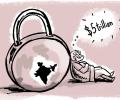
India's jugalbandhi with coal and clean energy is coming unstuck, neither achieving adequate renewable generation nor ensuring sufficient coal-fired power in the quest to become a $5-trillion economy. Six months have elapsed since Prime Minister Narendra Modi announced an ambitious climate agenda for India at COP26 at Glasgow. The net zero emissions target by 2070 is a distant one, but there are nearer-term plans to meet 50 per cent of energy demand with renewables by 2030 by increasing capacity to 450 Gw. A cursory look at the balance sheet of India's climate progress since November reveals ponderous progress towards meeting the renewables target even as the country is scrambling to expand coal-fired generation in the face of a power crisis.

Better than projected revenues from the spectrum auction for 3G services and Broadband Wireless Access is likely to reduce the Centre's fiscal deficit to 4.47 per cent of the GDP during 2010-11 from an estimated 5.5 per cent and curtail its huge borrowings.

On the eve of the Budget presentation, economists on Thursday said the they expect the government to roll back some of the stimulus measures, as the economic growth is on rebound with the Economic Survey projecting the GDP to expand by up to 8.75 per cent in FY'11.

Bold reforms and prudent monetary and fiscal policies by the incoming Narendra Modi government will help the economy to grow at 6.5-7 percent, says a report.
